
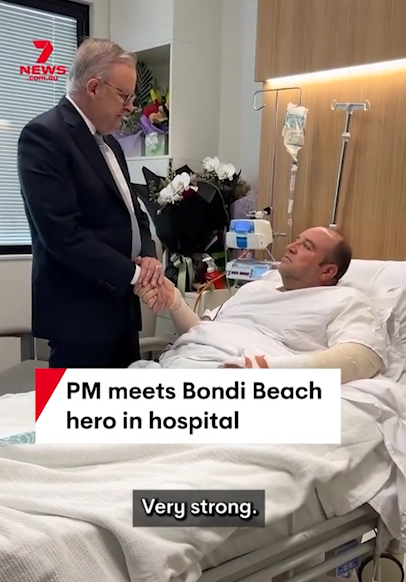
In a softly lit hospital room, far from crowds and cameras, a powerful moment unfolded that quickly resonated across the nation. A man lying in a hospital bed — injured, exhausted, yet unbroken — reached out and clasped the hand of the country’s Prime Minister. No speeches. No grand statements. Just a simple exchange that spoke louder than words.
The image shows the Prime Minister standing beside the bed, dressed formally, leaning slightly forward as he listens intently. The patient, wrapped in white sheets and connected to medical equipment, looks up calmly. Despite the injuries that brought him there, his expression carries quiet determination. The caption circulating with the image sums it up in just two words: “Very strong.”
This man is being recognized as a Bondi Beach hero — someone whose actions in a critical moment helped protect others and prevent a situation from becoming far worse. While details of the incident have been widely discussed elsewhere, this hospital visit shifts the focus away from chaos and toward recovery, gratitude, and human connection.
Hospital rooms often reveal truths that public stages never do. There are no uniforms of heroism here, no applause, no headlines scrolling by. Just vulnerability. Tubes, monitors, IV stands, and the slow rhythm of healing. And yet, it is precisely in this setting that courage feels most real.
Witnesses say the Prime Minister took time to personally thank the man, acknowledging not just what he did, but what he endured. Flowers in the background and the careful attention of medical staff underscored the seriousness of the injuries — and the significance of the visit. It wasn’t about politics. It was about respect.
Across social media, the reaction was immediate and emotional. Many praised the hero’s strength, calling him a symbol of everyday bravery — proof that ordinary people can rise in extraordinary moments. Others focused on the image itself, noting how the simple act of holding hands carried more meaning than any formal ceremony ever could.
Healthcare workers often say that recovery is not just physical. Emotional support, recognition, and reassurance play a major role in healing. Seeing the nation’s leader stand bedside, acknowledging sacrifice, sent a message not only to the patient but to the public: courage does not go unnoticed.
Parents, first responders, and beachgoers alike shared the image with messages of gratitude. Some wrote that it reminded them how quickly life can change. Others said it restored their faith in humanity during a time when good news feels rare. Many agreed on one thing — strength doesn’t always shout. Sometimes it lies quietly in a hospital bed.
As the man continues his recovery, this moment will likely remain etched in the public memory. Not because of who stood beside the bed, but because of what the moment represented: resilience, humility, and the unspoken bond between a nation and someone who stepped forward when it mattered most.
In a world full of loud headlines, this was a quiet reminder — true strength doesn’t need an audience. It simply endures.