
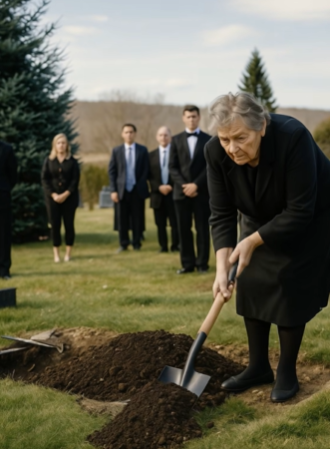
In a scene heavy with solemnity, an elderly woman takes the shovel into her own hands.
Surrounded by mourners dressed in black, she walks forward—not as a bystander, but as someone ready to participate in the final chapter of a life once shared.
Her face reflects quiet strength and sorrow, carrying a weight words cannot hold.

Shoveling Through Silence
With every motion, she lowers the blade into the earth, her hands steady but aged. Each scoop is slow and deliberate.
It is not just dirt she moves—it is memory, it is grief, it is the symbolic act of laying someone to rest with the tenderness only a heart full of love can muster.

Witnessed by Grief, Honored by Action
As others look on—silent, respectful, grieving—she alone stands at the edge of the grave, doing what many cannot bring themselves to do.
The choice to shovel is not out of obligation, but out of devotion. It is a gesture that says: “I was here. I loved you. And I will honor you, even in this.”
A Goodbye You Give Yourself
The last image captures her in motion, lifting a full shovel of soil, eyes down, mind perhaps full of flashbacks.

It is a powerful moment. There are few greater acts of farewell than lowering the earth yourself, offering your own hands in the process of closure.
This is not just mourning—it is participation in the ritual of letting go.
The Strength of a Final Goodbye
Funerals are moments when time slows, when people gather to mourn, remember, and sometimes—to act.

In this powerful sequence, one woman chooses to not only say goodbye but to be the goodbye.
And in doing so, she transforms grief into grace, pain into purpose.